

 CN
CN
The MEz manufacturer customizes the u О n И -13/55 crack-resistant electrode E7015 carbon steel bridge and pipeline welding electrode
Master Structural Welding with УОНИ‑13/55 (E7015) Low Hydrogen Electrodes
In the demanding world of structural fabrication and repair, the integrity of every weld is paramount. For professionals working on critical infrastructure like bridges, industrial steel frames, cranes, and heavy engineering machinery, selecting the right consumable is not just a choice—it's a responsibility. The УОНИ‑13/55 E7015 carbon steel welding electrode stands out as a trusted solution engineered for such high-stakes applications. This guide delves into why this specific electrode is a top choice for fabricators and exporters targeting robust markets, particularly in regions like Africa.
Understanding the УОНИ‑13/55 (E7015) Specification
The designation УОНИ‑13/55 follows a recognized classification system, while E7015 is its AWS (American Welding Society) equivalent. The 'E' stands for electrode, '70' indicates a tensile strength of 70,000 psi, '1' specifies it's for use in all positions, and '15' denotes a low-hydrogen iron powder, DC reverse polarity (DCEP) electrode. This combination is specifically designed for welding low-alloy, high-strength steels where crack resistance is crucial.
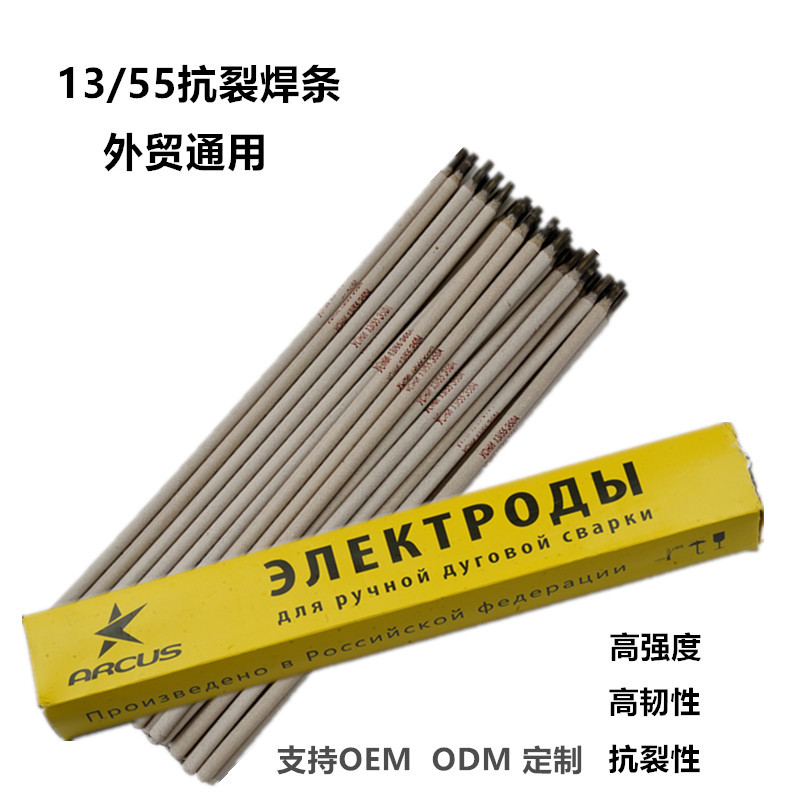
Key Features & Technical Advantages
- Low Hydrogen, Alkaline Coating: The alkaline (basic) flux coating is key to producing welds with extremely low levels of diffusible hydrogen. This dramatically reduces the risk of hydrogen-induced cold cracking, a common failure in thick materials and restrained joints, making it ideal for structural integrity.
- Exceptional Mechanical Properties: Welds made with E7015 electrodes offer excellent notch toughness and consistent mechanical properties, even under dynamic loads, which is essential for structures like bridges and cranes.
- Optimal Arc Performance: Provides a stable, smooth arc with deep penetration and a easily removable slag. The weld bead appearance is typically convex and of high quality.
- Precise Specifications: With a 4.0mm diameter and a standard 400mm length, this rod is suited for medium to heavy plate welding. The recommended welding current range of 90-220A offers wide operational flexibility.
Ideal Applications: Where This Electrode Excels
The УОНИ‑13/55 E7015 is not a general-purpose rod; it's a specialist. Its primary applications are in sectors where safety and durability are non-negotiable:
- Bridge Construction & Repair: For joining girders, piers, and other load-bearing components.
- Industrial Steel Structures: Erection of factory buildings, warehouse frames, and transmission towers.
- Heavy Lift Equipment: Fabrication and maintenance of crane booms, gantries, and excavator frames.
- Pressure Vessels & Pipelines (where specified): For carbon steel sections requiring high-strength, crack-resistant welds.
Why Choose This Product for Export & Cross-Border Trade?
This product is labeled as a cross-border export-specific supply, highlighting its suitability for the international market, with Africa noted as a primary sales region. Its robust performance meets the growing infrastructure development needs across the continent. The clear specification (订货号: 26041166) ensures easy ordering and logistics. Being manufactured in China by a specialized МЭЗ (Welding Electrode Plant) allows for reliable quality at a competitive price point, a crucial factor for large-scale projects and distribution businesses on platforms like Amazon.
Handling & Best Practices for Optimal Results
To leverage the full potential of low-hydrogen electrodes, proper storage and handling are mandatory. These rods must be kept in their original sealed packaging until use and stored in a dedicated oven at temperatures between 250°C to 350°C to prevent moisture absorption. Re-drying is often required if the packaging is compromised. Always use DC electrode positive (DCEP) polarity and ensure the base metal is clean and free of contaminants like rust, oil, and paint.
Conclusion
For engineers, project managers, and welding supply distributors involved in critical carbon steel construction, the УОНИ‑13/55 E7015 low hydrogen electrode represents a blend of proven performance and practical reliability. Its specifications—from the 4.0mm diameter suited for substantial material thickness to its specialized alkaline coating—are purpose-built to deliver strong, crack-resistant welds in structural applications. By choosing this electrode, you are investing in the longevity and safety of the built environment, a decision that pays dividends in project success and reputation.